
Abstract / Introduction
LED full-color displays are widely used in outdoor advertising curtain walls, indoor command centers, cultural tourism venues, commercial complexes, and other scenarios. The temperature rise control during long-term continuous operation directly determines the panel lifespan, display color stability, and system maintenance costs. During the project design phase, the actual power consumption of the display, internal heat load assessment, and selection of air conditioning/ventilation equipment are core technical indicators of concern for integrators, project owners, and HVAC design firms.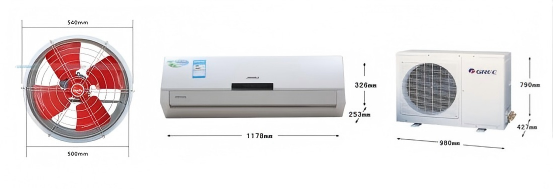
This article is based on industry‑standard opto‑electro‑thermal conversion theory, correction factors for heat dissipation in outdoor enclosed cabinets, and standardized ventilation airflow calculation formulas. Combined with real engineering case studies, it provides a step‑by‑step breakdown of the heat load calculation logic and outputs a standardized selection process for air conditioners and axial fans that can be directly used in project quotations, construction detailing, and HVAC supporting design. The approach balances equipment reliability with project cost control, avoiding two common industry problems: insufficient cooling leading to overheating and system crashes, or excessive redundancy causing budget waste.
1. Basic Conversion Logic between LED Display Power Consumption and Internal Heat Load
LED luminescence is an opto‑electro‑thermal energy conversion process: only a portion of the input electrical energy is converted into visible light, and the remainder is released as heat – the primary heat source for temperature rise. Extensive field measurements of module temperature rise have established a unified conversion standard, providing a benchmark for cooling equipment selection.
1.1 General Parameters for Opto‑Electro‑Thermal Conversion and Heat Distribution
For conventional commercial full‑color LED displays, the opto‑electrical conversion efficiency is only 20%–30%; the rest of the electrical energy is converted into heat. This heat is divided as follows:
Total heat generation accounts for 70% of the total input power; the remaining 30% is emitted as light.
Of that 70% total heat, 20% can be dissipated to the ambient environment through natural radiation from the front and rear surfaces of the display; the remaining 50% is trapped inside the enclosed cabinet behind the display and constitutes the effective heat load that must be removed by air conditioners or fans.
Core formula:
Effective internal heat load Q = Total average power consumption of the display × 50%
1.2 Standard Heat Load Calculation Example for an Outdoor Screen
Project baseline parameters: outdoor high‑definition LED screen, average operating power 500 W/m², total screen area 50 m².
Total average input power of the screen:
P<sub>total</sub> = 500 W/m² × 50 m² = 25,000 W = 25 kW
Effective heat load trapped inside the cabinet:
Q = 25,000 W × 0.5 = 12,500 W = 12.5 kW
Note: This value accounts only for the heat generated by the display itself. For outdoor screens, solar radiation heat gain must be added as a safety margin in air conditioner selection.
2. Standardized Selection Method for Air Conditioning Systems in Outdoor Enclosed LED Cabinets
The maintenance compartment behind an outdoor LED screen is a narrow, enclosed space – typically only 0.8–1 m wide, far smaller than a standard room. Heat accumulates rapidly, and heat exchange efficiency is significantly enhanced. Actual measurements show that the cooling effect of a given air conditioner inside such a cabinet is approximately 3 times that in a normal room. Therefore, a 3‑fold efficiency correction factor must be introduced in the selection calculation.
2.1 Reference Table for Nominal Cooling Capacity vs. Horsepower (HP) Rating
Note: The table originally included a reference; however, the numerical data is not provided in the uploaded text. In practice, the "rated cooling capacity" (in W or kW) is the key selection parameter, not the HP designation, because HP ratings vary among brands. The effective cooling capacity inside the cabinet is the actual heat removal capability after applying the 3‑x correction factor.
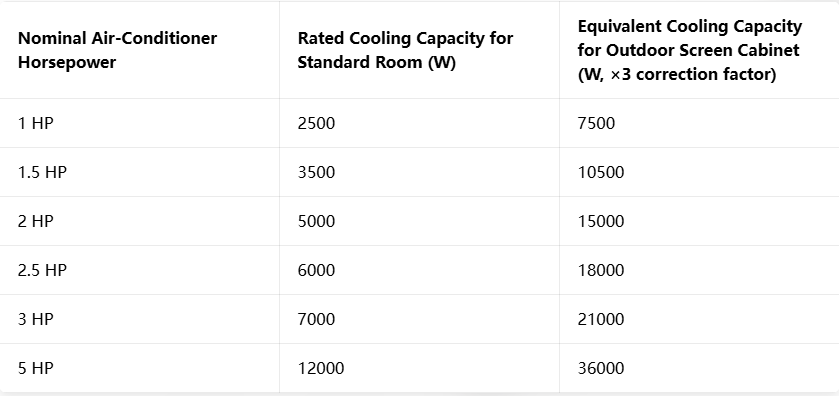
Important distinction: The rated cooling capacity of an air conditioner is not its input power consumption. Cooling capacity represents the total heat that the unit can remove from the enclosed space per unit time. The selection must match the heat load against the cooling capacity – do not confuse it with electrical power draw.
2.2 Four‑Step Standardized Air Conditioner Selection Process (Using the 50 m² Outdoor Screen Example)
Step 1: Calculate the effective internal heat load Q
Q = 500 W/m² × 50 m² × 0.5 = 12,500 W
Step 2: Convert to the equivalent reference heat load for a normal room
Because the cabinet heat exchange efficiency is 3 times higher, the internal heat load must be back‑calculated to an equivalent heat load that matches the manufacturer’s rated cooling capacity:
Equivalent reference heat load = Q ÷ 3 = 12,500 W ÷ 3 ≈ 4,167 W
Step 3: Add solar radiation redundancy for outdoor installation
Outdoor curtain walls are exposed to direct sunlight; glass and aluminum frames continuously absorb heat. An additional 40%–50% cooling redundancy is required. For temperate regions, 40% is typical; for high‑temperature, sun‑exposed areas (e.g., southern China, western regions, large outdoor screens), 50% is recommended.
Required total rated cooling capacity ≥ 4,167 W × 1.4 = 5,832 W (for 40% margin)
Step 4: Combine and select air conditioner units
Based on the cooling capacity reference table, evaluate combination options:
Option 1: Two 1‑HP units – total rated cooling capacity 5,000 W (slightly below the 5,832 W requirement); risk of insufficient cooling under high‑temperature conditions – not recommended.
Option 2: One 1.5‑HP unit + one 1‑HP unit – total rated cooling capacity 6,000 W; adequate redundancy to cover both internal heat and solar radiation – optimal configuration.
3. Forced Ventilation Calculation Using Axial Fans for Open/Semi‑Open Cabinets
For non‑enclosed cabinets, budget‑constrained projects, or low‑heat‑load applications (indoor displays, open‑frame outdoor grille screens), axial fans provide a low‑cost ventilation solution. They rely on air exchange to remove accumulated heat. The total fan airflow and number of fans are determined based on cabinet volume and required air changes per hour.
3.1 Core Ventilation Airflow Formulas
Cabinet internal volume: V = Screen area × Cabinet depth (maintenance passage width)
Total required air exchange per hour: Industry standard minimum air changes = 100 times/hour to ensure rapid heat removal.
L<sub>total</sub> = V × 100
Number of fans: Total airflow ÷ Rated exhaust airflow per fan, rounded up to the next integer, with a safety margin.
3.2 Fan Calculation Example for a 200 m² Outdoor Open‑Frame Screen
Given: Screen area = 200 m², cabinet depth = 0.8 m, single axial fan rated airflow = 5,300 m³/h.
Cabinet volume: V = 200 × 0.8 = 160 m³
Required total air exchange per hour: L<sub>total</sub> = 160 × 100 = 16,000 m³/h
Theoretical number of fans: N = 16,000 ÷ 5,300 ≈ 3.02 → round up to 3 fans.
3.3 Professional Guidelines for Fan Installation and Air Duct Design
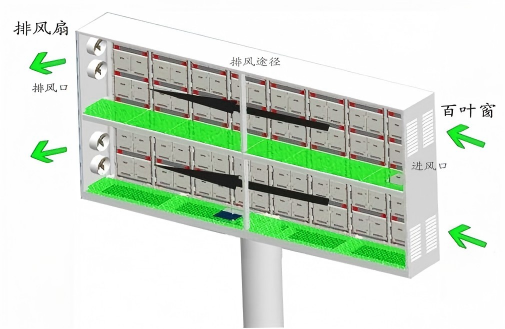
Natural convection preferred: Install exhaust axial fans at the top of the cabinet, and leave large intake louvers at the bottom. This leverages the natural upward rise of hot air, improving heat exchange efficiency by more than 30%.
Horizontal cross‑flow alternative: Install intake fans on one side and exhaust fans on the opposite side to create a horizontal circulation path – suitable when vertical space is limited.
Cabinet depth control: Maintain a rear passage width of 600–800 mm. Excessive width reduces airflow velocity and creates dead zones where heat accumulates, weakening the ventilation effect.
Weather protection: Outdoor fans must be equipped with insect‑proof and rain‑proof louvers to prevent moisture and dust from entering the cabinet and corroding power supplies and driver boards.
4. Key Technical Control Points for Power Consumption and Cooling/Ventilation Design
4.1 Distinguish Average Power vs. Peak Power for Different Operating Conditions
All calculations in this article are based on the module’s average operating power, suitable for typical playback at 70% brightness. If the project requires continuous full‑brightness, 24/7 operation (e.g., traffic information displays, high‑brightness outdoor advertising screens), the calculation baseline must be changed to use peak power consumption × 50% to recalculate the heat load, with a corresponding increase in cooling redundancy.
4.2 The Decisive Selection Criterion is Rated Cooling Capacity, Not HP Rating
Different brands may have inconsistent HP definitions; the same HP rating can correspond to different cooling capacities. During design and procurement, the rated cooling capacity (in W) marked on the unit’s nameplate must be the sole matching criterion – do not rely solely on the HP number.
4.3 For Large Displays, a Combined “Air Conditioner + Fan” Cooling Architecture is Recommended
For outdoor LED screens larger than 80 m², using only air conditioners often leads to local airflow dead zones and heat accumulation. A combined approach – air conditioners providing the base cooling and fans continuously circulating air inside the cabinet – helps equalize the temperature field and significantly reduces the risk of local hot spots that can damage LEDs or driver boards.
4.4 Simplified Calculation for Indoor Displays
Indoor installations have no solar radiation heat gain, so the solar redundancy coefficient is not needed. For indoor enclosed cabinets, the 3‑x heat exchange correction factor still applies. For open indoor hall screens where the rear is not enclosed, fan‑only ventilation is usually sufficient, and air conditioning is not required.
 Creative Shaped LED Screen
 holographic invisible LED screen
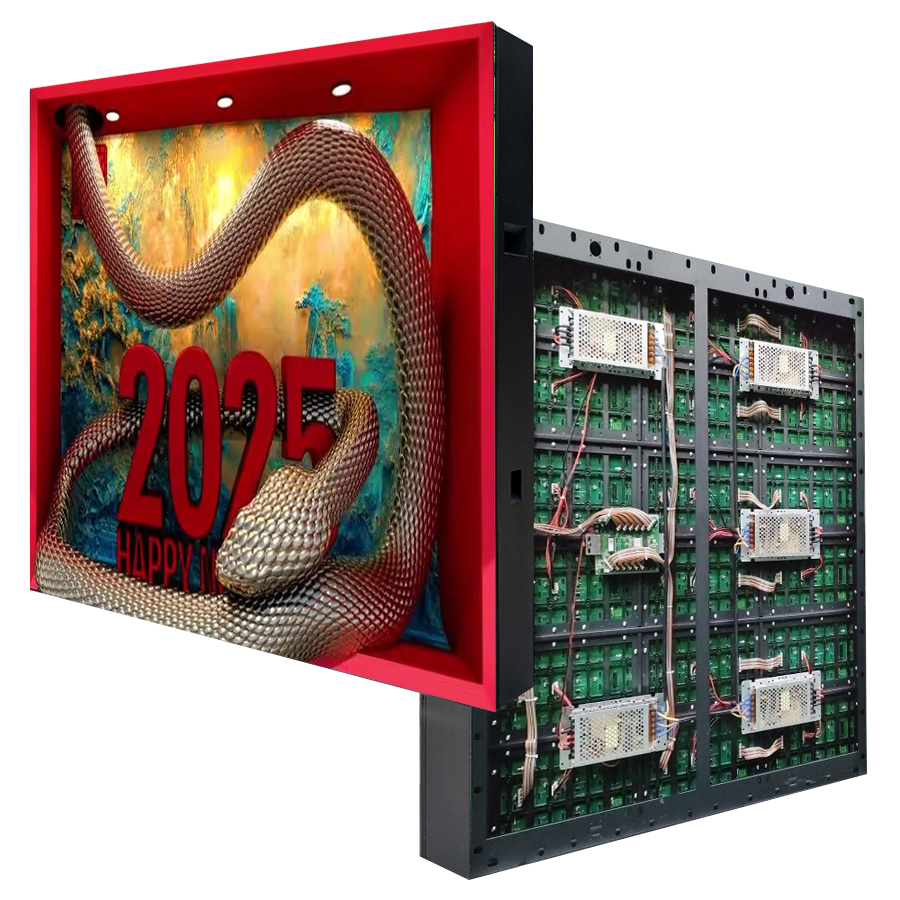 Outdoor LED screen
 August 15,2026
 August 03,2026
 August 02,2026
Copyright ©2025 All Rights Reserved by Shenzhen Argo Optoelectronic Technology Co.,Ltd.